
TL;DR
Many business owners hesitate before making major hiring or investment decisions, not because they lack ambition, but because they lack financial clarity. When reporting is inconsistent, cash flow visibility is weak, and forecasting is reactive, even good opportunities can feel risky. Businesses that scale confidently are not guessing; they see more clearly through stronger financial infrastructure, better reporting, and leadership-level financial guidance.
The Problem Usually Is Not Fear
Every owner knows the feeling.
The workload keeps growing. Your team is stretched thin. Customers need more capacity than your operation can comfortably support. Maybe your equipment is aging. Maybe your operations manager is wearing three jobs at once. Maybe you know the business needs another hire, but every time you get close to making the decision, the same question surfaces:
“Can we really afford this?”
Most people assume hesitation like this comes from fear, indecision, or lack of confidence. In reality, it is often something much simpler and far more common: incomplete financial visibility.
Early in a company’s life, intuition can carry a surprising amount of weight. Owners know every customer, every expense, and every operational pressure point. But as businesses grow, complexity expands faster than financial infrastructure usually does. Payroll grows. Projects overlap. Margins fluctuate. Financing obligations increase. The cost of a wrong decision becomes more significant.
At that stage, instinct alone becomes less reliable.
Growth Creates Financial Fog
One of the biggest misconceptions in business is that growth automatically creates stability.
In reality, growth often exposes weaknesses that smaller businesses were previously able to survive with. A company can be increasing revenue while simultaneously losing visibility into profitability, cash flow, and operational efficiency.
That creates a type of financial fog many owner-led companies quietly experience:
Revenue is increasing
Demand is strong
The company appears healthy externally
But leadership internally does not fully trust the numbers
This tension is becoming increasingly common. According to the National Federation of Independent Business, uncertainty among small business owners recently reached historically high levels, with many delaying hiring and capital investments due to a lack of confidence in future financial conditions and predictability. (NFIB)
The issue is rarely ambition.
The issue is visibility.
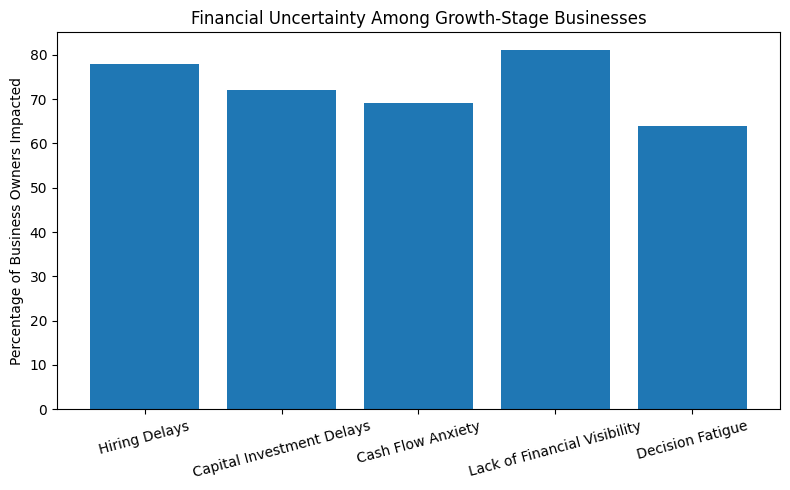
Delayed Decisions Become Expensive
Poor financial visibility not only leads to bad decisions but also delays them.
A postponed hire can overload leadership for another year. Delayed equipment purchases can create operational bottlenecks that quietly reduce profitability and customer experience. Waiting too long to build a financial structure often leaves founders carrying responsibilities the business should already have outgrown.
This is where decision fatigue begins to set in for many growth-stage companies. Every major move starts to feel heavier because leadership lacks reliable visibility into its consequences.
Questions that should have clear financial answers instead become educated guesses:
What happens to cash flow if we hire now?
Can current margins support additional debt service?
Are we becoming more profitable or simply busier?
If revenue slows temporarily, how exposed are we?
Which parts of the business are actually driving margin?
These are operational decisions with financial consequences. According to research from PwC, financial uncertainty and a lack of operational visibility remain major obstacles preventing middle-market businesses from making confident strategic decisions. (PwC)
Reports Are Not the Same as Clarity
Many businesses believe they already have financial visibility because they receive monthly reports.
But reports alone are not clear.
In many companies, financial statements arrive late, lack operational context, or are designed primarily for compliance rather than leadership decision-making. Historical reporting explains what has already happened. Strong financial infrastructure helps leadership understand what is likely to happen next.
That difference matters more as complexity increases.
Cash flow forecasting, KPI visibility, profitability analysis, and scenario planning are not “advanced finance tools” reserved for large enterprises. For growth-stage businesses, they are decision-making tools that reduce ambiguity and improve timing.
Research from McKinsey & Company has consistently shown that companies with stronger financial planning and operational visibility outperform peers during periods of volatility because they can allocate capital more quickly and make decisions with greater confidence. (McKinsey)
That distinction is central to how Acullence positions its work. The objective is not simply cleaner books or prettier reports. The objective is financial clarity that helps leadership make stronger decisions with less uncertainty.
Why Financial Clarity Changes Leadership
One of the biggest misunderstandings about experienced business owners is that they eventually stop feeling financial pressure.
Most do not.
In many cases, the pressure increases because the consequences become larger:
More employees are relying on payroll
Larger operating expenses
Greater financing obligations
Higher customer expectations
More downside when decisions go poorly
This is why financial clarity matters emotionally as much as operationally.
When leadership has accurate reporting, forward-looking forecasting, and reliable visibility into margins and cash flow, decisions stop feeling reactive. The business may still face risk, but leadership understands the timing, tradeoffs, and likely outcomes more clearly.
That changes how owners lead.
Hiring becomes more strategic instead of emotional. Investments become measured instead of reactive. Conversations with lenders, investors, and leadership teams become more productive when decisions are grounded in reliable information rather than instinct alone.
What Strong Financial Infrastructure Actually Looks Like
For most growth-stage businesses, a strong financial infrastructure is not complicated in theory. It simply requires consistency, visibility, and leadership-level interpretation.
That often includes:
Accurate monthly reporting delivered consistently and on time
KPIs tied directly to operational performance
Rolling cash flow forecasting
Margin visibility by customer, service line, or project
Leadership finance reviews focused on decisions, not just reporting
Strategic financial guidance connected directly to business operations
Acullence’s own case studies repeatedly show that companies struggling with growth pressure often improve dramatically once financial visibility and operational reporting become more structured.
The breakthrough is rarely one dramatic financial event.
Usually, the steady installation of the structure reduces ambiguity over time.
The Best Decisions Usually Feel Calm
One of the clearest signs that financial infrastructure is working is psychological in nature.
Important decisions stop feeling chaotic.
Not easy.
Not risk-free.
But clear.
The hire may still be expensive. The expansion may still carry uncertainty. But leadership understands the implications well enough to act deliberately rather than emotionally.
That is what financial clarity ultimately creates:
Better decision-making
Better timing
Better operational discipline
Greater leadership confidence
More sustainable growth
Because businesses rarely struggle from a lack of opportunity alone.
More often than not, they struggle to make increasingly important decisions without sufficient visibility into the consequences.
For 15 years, Acullence has helped business owners make clearer decisions, protect profitability, and grow with confidence.