
A rolling forecast should help an owner decide whether the business can afford its next move before committing to it. It offers insight on whether to hire, what to spend and when, which growth to pursue, and what to do if revenue or collections fall short. It is updated as actual results come in, usually monthly or quarterly, so it always looks a set distance ahead instead of stopping at year-end.
Executive Summary
• Without a model behind forecasts, you're guessing.
• A rolling forecast is updated as results come in and always extends a set distance ahead, so it stays useful long after the annual budget has drifted.
• Its value shows up in the decisions it changes: hiring, spending, growth, and downside planning.
• Books record where the business has been. Tax work shows what is owed. A forecast shows what the business can do next. You need to know all three.
• A good forecast will sometimes say no. That answer, delivered early, protects cash, time, and the owner's options.
Forecasting what you can carry
"Can we really afford it?"
So many owners ask the exact same question every week. About a new hire. A second crew. A piece of equipment. Outsourcing.
The problem is that most of the time, those questions are never answered. Owner-led businesses are usually so busy working on the current bank balance, fears for the next quarter, and the memory of last month's tight budget that they never return to them.
Nobody bothered writing down the notes, so the forecast is dead.
"We can afford it" has the same problem. A particularly nice balance in payroll, taxes, and debt payments usually means you don't have to wait to splurge on that equipment you've had your eye on.
Both sides of the equation are hard to accurately predict. Profit and cash answer different questions, and the bank balance only provides a snapshot of one moment.
What you really need: Show me the months ahead.
What a rolling forecast is, and why the annual budget fades
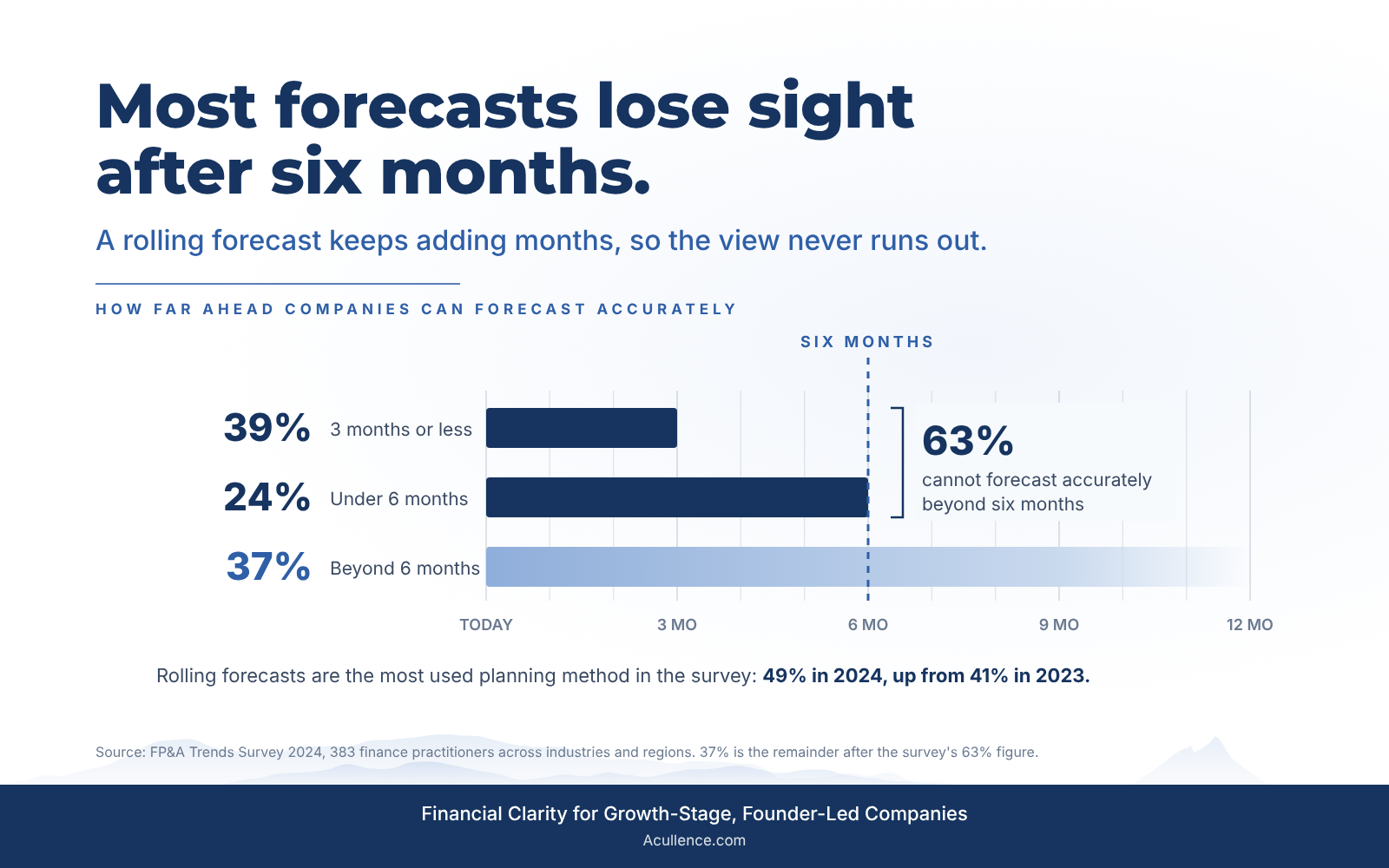
BLS Employer Costs for Employee Compensation, June 2026, and the FP&A Trends Survey 2024
Picture your last annual budget discussion. You set it before the year began, and everyone in leadership expects you to set targets the team can keep.
Within a few months, though, your budget has entries you weren't expecting. A large customer pays late. A job is cut. A supplier raises prices. The budget starts to drift further and further from reality. Making decisions on it starts to make less and less sense.
A rolling forecast, on the other hand, keeps the current budget in scope. The team replaces forecast months with actual results on a monthly or quarterly basis, updates the assumptions that changed, and adds new months at the end. The budget is always based on a current view of roughly the next year, and that view reflects what happened last month.
We have a name for how many owners treat finance: broccoli. You eat it because you're supposed to, then you move on to dessert.
Your annual budget usually gets the same treatment. A rolling forecast becomes much more flexible and the better option to reach for when a consequential decision is on the table.
Five decisions a rolling forecast should help you make
1. Can we afford the next hire? A new role means payroll taxes and benefits come on top, and most roles take time to ramp before they produce. The forecast shows when the cash leaves, when the role is expected to pay for itself, and what happens if that takes longer than planned.
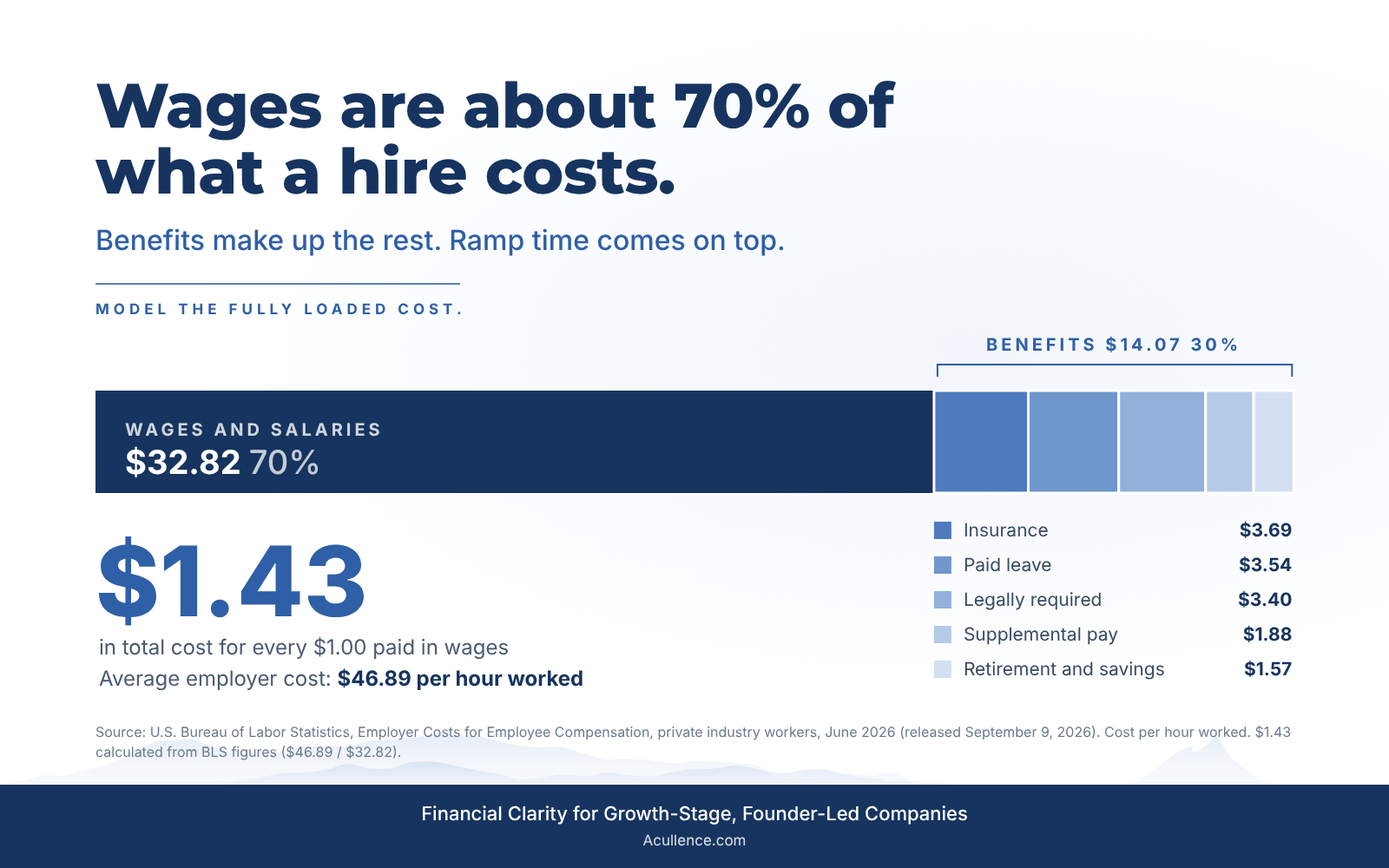
BLS Employer Costs for Employee Compensation, June 2026, and the FP&A Trends Survey 2024
The question to model: If we hire in January, what does cash look like in June if revenue grows more slowly than we expect?
2. What should we spend, and when? Equipment, software, vehicles, a new location. But timing is often as important as the purchase itself. The forecast shows whether a purchase fits this quarter, fits better next quarter, or needs financing to protect working capital.
3. Which growth should we say yes to? A large new customer or contract can absorb cash before it produces any. Materials, labor, and longer payment terms all come first. The forecast shows how much cash a growth opportunity will require, for how long, and whether the margin justifies it.
4. What happens if things go wrong? Something always does. A useful forecast includes at least one downside scenario. What if the largest customer leaves? What if collections slow by 30 days? What if a key cost rises?
The question to model: How many months do we have under the downside case, and which levers do we pull first?
5. Can the business fund the plan we are about to approve? Financial planning means new hires, new markets, new capacity. A strategic plan with no financial accountability behind it is a set of intentions. The forecast turns the plan into dates, dollars, and owners, and shows whether the business can carry it.
Who is showing you what comes next?
Your business likely already has good people working with the numbers. A bookkeeper to keep the books timely, accurate, and clear. A tax professional to report the business's activity to the IRS and keep it compliant. A controller, where there is one, to close the books on time and put controls in place.
Each also looks at the business from its own angle. The books record events. Tax work looks at compliance and what's owed. Modeling what the business can fund next, in what order, and under which scenarios is entirely different. That is CFO work.
If your plan is to upgrade from a bookkeeper to an accountant, expect better books and cleaner filings. You still won't have anyone modeling the next twelve months.
A good forecast will sometimes tell you no
A good forecast rarely gives a flat no. More often, the answer is "not yet" or "not in that order."
The answer is usually about sequence. Collect the receivables that are 60 days past due, then hire. Line up financing, then sign the lease. Finish the big job, then bid the next one. The decision often stays the same. The order changes, and the order is what protects cash.
Set your tripwires before you commit. Before you make the hire or sign the contract, decide which numbers would make you pause or reverse it. If the new territory is below a set revenue level by month six, you stop adding staff there. If collections slip past a set number of days, the equipment purchase waits. Once the money is spent, it's much harder to admit a decision isn't working.
Sometimes the answer is "don't hire us yet." When an owner tells us they don't have the cash for outside financial leadership, we look at the numbers before we argue. Sometimes they show the engagement can pay for itself. Sometimes they show the business needs to fix collections or margin first. We'll tell you which.
What Acullence experience shows
PROOF GATE
Client-supplied Acullence evidence. Both cases were also used in Newsletter #1. Publish figures or identifying details only after client permission and anonymization are cleared.
Deciding before the deadline: A growth company came to Acullence with books roughly six months behind, no financial analysis, and a fundraising round ahead. On its current path, the company was projected to run out of cash before the raise could close. Acullence rebuilt the financial foundation and put strategic cash planning and investor-ready analysis in place, which gave leadership a way to see which decisions had to happen before the raise and how much time each option bought. The company ultimately exceeded its fundraising target by more than $1 million.
Making the business forecastable: A second-generation owner of a regional service business was dealing with volatile monthly profit, limited financial visibility, and a five-year exit goal. A forecast built on boom-or-bust results is hard to trust. Over the engagement, recurring revenue grew from 22% to 65% of the business, and net margin improved from 6.1% to 14.3%, supported by better scheduling and a steady management cadence. A more predictable business produced a forecast the owner could plan an exit around.
A practical tool: the Next-Decision Test
Before committing to a hire, a purchase, or a growth opportunity, run it through five questions. If you can answer them with numbers, you are ready to decide.
1. What does this decision cost, fully loaded, and when does the cash actually leave?
2. When does it start producing revenue or savings, and what happens if that takes twice as long?
3. With this decision included, what does cash look like at its lowest point in the next twelve months?
4. What would we delay, stop, or finance to make room for it?
5. What would tell us to reverse course, and when would we know?
The Acullence perspective
A forecast is never perfect. Customers, costs, and markets move. But it can show you which decisions your business can fund, which ones need to wait, and which windows are closing. And that shift is purely based on experience.
Frequently Asked Questions
What is a rolling forecast? A financial projection updated on a regular cycle, often monthly or quarterly. Each update replaces forecast periods with actual results, revises assumptions, and adds a new period at the end, so the forecast always extends a set distance ahead.
How is a rolling forecast different from a budget? A budget is usually set once a year and describes planned targets. A rolling forecast is updated throughout the year to reflect what is actually happening. Many businesses use both: the budget for targets and accountability, the forecast for decisions.
How often should a rolling forecast be updated? Monthly and quarterly cycles are both common. Businesses with fast-changing cash, seasonal swings, or active growth decisions often benefit from monthly updates.
How far ahead should a rolling forecast look? Many businesses look roughly twelve months ahead, and some extend further when a large decision, financing, or transition is on the horizon.
Can my bookkeeper or CPA build a rolling forecast? Some can build the spreadsheet. The harder part is the judgment behind it: choosing the assumptions, building realistic downside scenarios, and connecting the numbers to specific decisions. That is strategic finance work, and it works best alongside a strong bookkeeper and CPA.
When does a growing business need a rolling forecast? Common triggers include a planned hire or major purchase, a large new customer or contract, financing or investor conversations, uneven cash flow, and planning for a transition or sale.
Next Step
FINANCIAL CLARITY SNAPSHOT
If you can't answer "Can we afford the next hire?" with numbers, the Free Financial Clarity Snapshot is a good place to start. It is a focused 45-minute conversation that shows where your financial visibility is strong, where blind spots may be limiting your decisions, and which 2 to 3 areas deserve attention before you commit to next year's plan. Schedule your Snapshot (https://www.acullence.com/free-financial-clarity-snapshot)